Augmented Intelligence in the Doctor’s Office
AI has infiltrated every aspect of our office patient care. Here is a snapshot in the Spring of 2026. (Which will need to be revised monthly or sooner...)
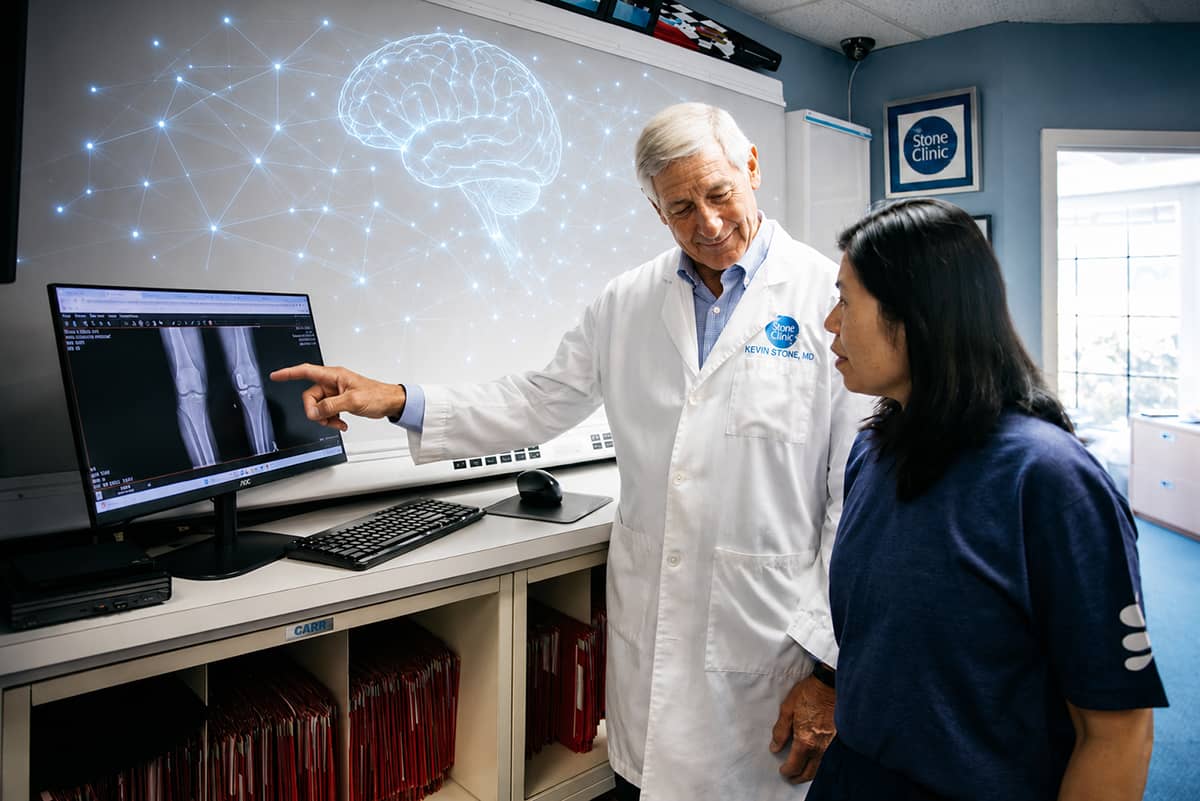
AI, for both the doctor and the patient, is augmented intelligence. Patients no longer need to remember their entire medical and surgical history, which medications they have taken (or are allergic to), or any of the other historical data points they used to write down at every visit. Their personal AI has it all and has organized it in relation to the injury they are presenting with today.
Every doctor is now empowered with not just the world’s knowledge but with the latest research data, clinical trial announcements, and novel drug approvals. In our orthopaedics realm, every MRI and X-ray can be read in real time by the doctor, the consulting radiologist, and the ever-present AI. While I am with the patient, interpreting the objective data in the context of the patient’s presentation and using my years of experience to provide judgment about whether or not to take action about an objective finding, both of us, patient and doctor, know it is very unlikely that anything important has been missed.
This process begins long before the patient gets to the office. Their initial phone call is answered by the AI receptionist, which can usually eliminate the on-hold problem and expertly direct the call to the appropriate person for faster service. AI’s off-hour availability means that appointments can be scheduled 24/7. Medical histories, X-rays, and MRIs are uploaded in advance (and will quickly be reviewed by the AI radiologist). Insurance company authorizations, when required, are submitted in advance (but they are still impossibly slow).
Surgical planning of robotic partial and total knee replacements is accomplished by CT 3D image creation. An experienced human robot technician is also present in the operating room to troubleshoot the robot and ensure the 3D surgical plan is optimized to the real-time reality of the patient’s knee. (By the way, every patient’s knee is different, unique to them, their biology, their history of trauma and use, and their goals…requiring judgement that robots will never have.)
Our rehabilitation programs still require daily hands-on tissue mobilization, exercise guidance, and coaching. The patient’s progress and follow-up programs after they leave the clinic are further optimized with personal wearables, providing data and patient input back to the rehabilitation team. While AI guidance to achieve specific metrics is helpful, motivation and individualization to improve adherence to the program are often very personal between the fitness team and the patient.
Patient care—before, during, and after surgery—is now augmented by an incredible digital network, wherein the entire team has access to the latest information to accelerate their recovery from injury.
Since most of the injuries I see come from mental errors, the athlete knew they were going too fast, knew just before the move that it might be risky, or were distracted when they landed from a jump, possibly the day will soon come when an AI agent may keep us out of the surgeon’s office in the first place. Alert to our strengths and weaknesses, it will warn us away from our own follies, our own distractions, and our predictably avoidable injuries.
In this augmented world, we potentially can be our best selves all the time.
