Lateral Partial Knee Replacements
Why are they so rare?
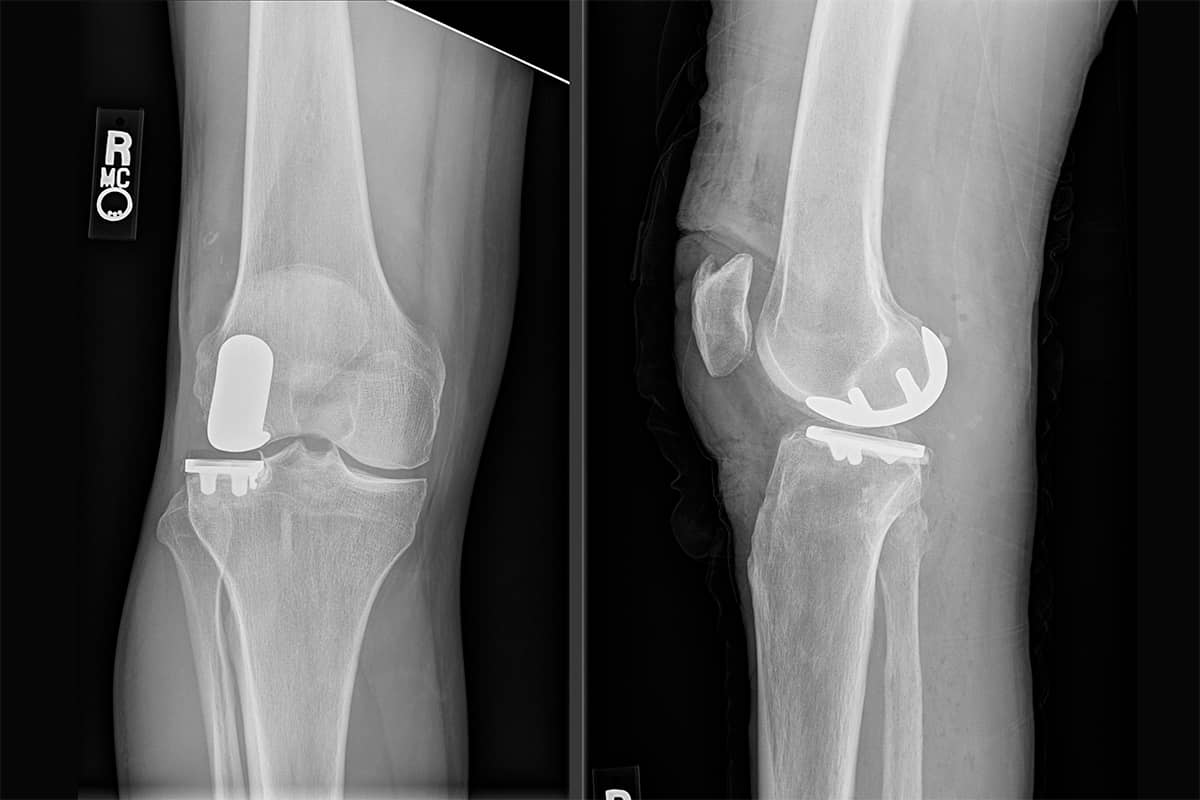
The lateral meniscus protects the articular cartilage-bearing surfaces of the knee. It absorbs about 70% of the forces of weight-bearing and stabilizes the knee by cupping the femur as the knee rolls backwards in flexion. The lateral meniscus is a key part of the entire knee complex.
People who lose their lateral meniscus, due to injury or surgical excision, develop lateral arthritis (i.e., on the outside parts of the knee) at an alarming rate. If the patient is a child and a surgeon exercises their discoid lateral meniscus, the child’s knees are doomed within a decade. If the patient is an athlete, each pivot and twist increases the wear on the joint, accelerating arthritis. And if someone already has arthritis, loss of the lateral meniscus increases their pain and causes the deviation of the leg often called “knock-kneed.”
Over time, loss of the lateral meniscus causes the knee to collapse, showing bone-on-bone on the X-ray. Most often these patients are told they need a total knee replacement; even surgeons who understand and perform partial knee replacements often recommend a total knee replacement for a lateral side collapse.
The reasons are complicated, but include the fact that the lateral compartment is different from the medial or inside part of the knee. The femur rolls farther back, and it rotates as it bends. Traditional lateral knee replacements had difficulty reproducing this arc of motion, which led to early failure of the artificial components.
What changed all this was the introduction of robotic surgery. By preoperatively making a 3D model of the patient’s own knee using specialized CAT scan software, each component of the partial knee (the femur cap and tibial tray) can be placed anatomically, then tested during surgery with real-time computer image feedback.
Every patient is a little different, and we learned how variable their knees really are. The tibial components often needed to be placed in 10 to 15 degrees of internal rotation, while the femoral components had to be as far lateral as possible to glide smoothly and stably together. The patients’ soft tissues—the ligaments inside and outside their knees—could be balanced with a combination of minimal bone resection and variable heights of the removable tibial trays.
Today, the partial lateral knee replacement patients are the happiest of all the knee replacement patients. Their ligaments are intact, their knees are straighter, and they return to full sports faster.
It’s not yet a perfect fix. All of these implants still require cement to fix them in place; they are so small that there is not enough surface area for bone to reliably grow into them and make them stable. But this is changing with new ingrowth designs just coming on the market.
There is no need to live in pain if you have bone-on-bone knee arthritis. Life is short, and it is almost always improved by the removal of pain, increased activity, and pursuit of athletic goals one thought were in the past.
Robotic Partial Knee Replacement: Replace Only What’s Damaged
If you have been told you need a total knee replacement, it is worth asking one important question: Does the whole knee truly need to be replaced?
Knees do not always wear out evenly. Sometimes one compartment of the knee is badly damaged while the rest of the joint still has healthy cartilage, working ligaments, and natural motion worth preserving. In those cases, robotic partial knee replacement may be a better fit than replacing the entire knee.
At The Stone Clinic, Dr. Stone does not make that decision from an X-ray alone. He evaluates the source of pain, the knee’s mechanics, imaging, ligament function, and the patient’s activity goals to identify the amount of surgery needed to restore function without replacing more of the knee than necessary.