Robotic vs. Manual Knee Replacement: Why Precision Matters
Knee Replacement for an Active Life
The goal of knee replacement should not be a quieter life. It should be a stronger return to the life you want to keep living.
Traditional knee replacement often relieves pain, but patients are commonly told to avoid running, impact sports, skiing, and other high-demand activities. With new robotic technology, knee replacement can move beyond simply resolving pain and instead work to restore full athletic function.
At The Stone Clinic, Dr. Stone is biased toward replacing injured knee tissues biologically with a BioKnee whenever possible. But for patients with true bone-on-bone, worn-out knees, robotic-assisted knee replacement can help athletes return to sports with a stronger, more natural-feeling knee.
How Robotic Knee Replacement Works
No two knees are exactly alike. Before surgery, a CT scan is used to create a 3D model of the patient’s unique knee anatomy. Dr. Stone uses that model to plan the implant size, alignment, position, and rotation around the mechanics of that individual knee.
At The Stone Clinic, robotic knee replacements are performed using the MAKO Surgical Corp Robotic Arm Interactive Orthopaedic System. During surgery, the robotic arm helps Dr. Stone carry out the personalized plan with exceptional precision. The robot does not replace the surgeon. It gives the surgeon a more accurate tool for placing the implant where it best fits the patient’s anatomy, while preserving healthy bone and soft tissue whenever possible.
Robotic Knee Replacement vs. Manual Knee Replacement
Manual knee replacement relies on mechanical guides, handheld saws, and the surgeon’s judgment in the operating room. Even in skilled hands, small variations in implant placement can affect how the knee feels, moves, and performs.
Robotic knee replacement begins with a personalized plan and uses robotic guidance to help execute that plan accurately. This precision supports better implant fit, more natural knee motion, and a broader return to activity than patients were often told to expect after traditional knee replacement.
Recovery After Robotic Knee Replacement
Recovery after robotic knee replacement is active from the start. Many Stone Clinic patients are weight-bearing almost immediately, walk out of the surgery center the same day, and begin physical therapy the next day.
Most patients begin physical therapy the day after surgery and progress quickly into guided movement. Driving, cycling, swimming, and sport-specific training are introduced as healing and strength allow, with many early milestones measured in weeks. With focused rehabilitation and clearance from the care team, many patients progress toward full activity and impact sports over the following months.
Explore the full recovery timelines here for partial knee replacement to total knee replacement.
Why Robotic Precision Matters for Sports and Activity
For active patients, precision is not just a technical advantage. It is what helps make higher-level activity possible after knee replacement.
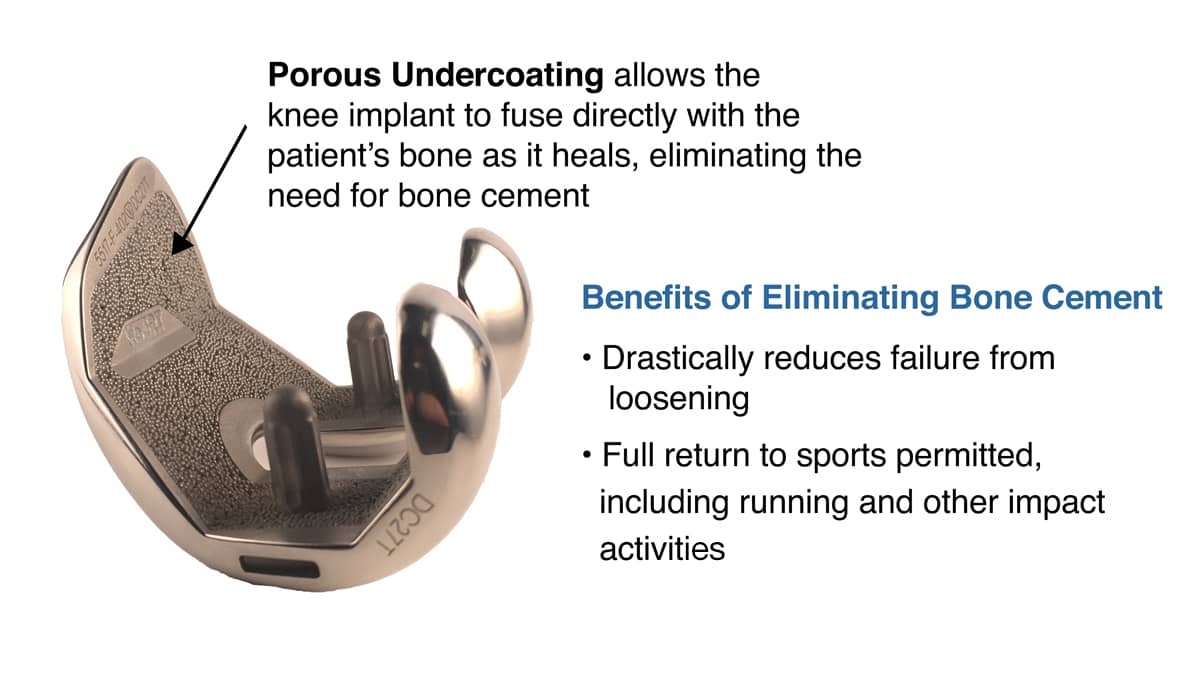
With robotic planning, careful soft-tissue balancing, and modern cementless implants that allow bone to grow into the implant, The Stone Clinic is helping redefine what patients can do after partial and total knee replacement. Patients who once may have been told to give up impact activity can now explore a return to the sports that matter most to them.
Learn More About Robotic Knee Replacement
For a deeper look at robotic-assisted knee replacement and athletic joint replacement at The Stone Clinic, explore:
- Robotic Joint Center at The Stone Clinic
- Robotic Partial Knee Replacement: Procedure details, recovery timelines, and patient stories
- Robotic Total Knee Replacement: Procedure details, recovery timelines, and patient stories
- Athletic Approach to Knee Replacement
Download the Saving My Knees Guide to explore knee treatment options designed to keep active people moving.
Could Robotic Knee Replacement Help You Return to Sports?
If knee arthritis is limiting your activity, robotic-assisted knee replacement may offer a chance to return to sports fitter, faster, and stronger than you've been in years.
Find out if robotic knee replacement can help you return to sports with a knee built for your anatomy, your goals, and your life.