Knee Pain Symptom Checker | Find Causes of Your Knee Pain
Experiencing knee pain but unsure what’s causing it? Our knee pain symptom checker helps you identify potential causes based on your symptoms.
Whether you're dealing with swelling, stiffness, or sharp pain, this tool provides expert-backed insights to guide your next steps. Use our interactive checker below to pinpoint possible conditions and discover the most advanced therapies to treat your injury. It won’t replace a real doctor and cannot give a definitive diagnosis but it can help you better understand your symptoms.
1
Select your injury body area & symptom(s) below
2
Select from list of possible conditions

Disclaimer: This tool is for information purposes only and provides only an approximate guide as to what may be wrong with your joints. It should not be used instead of seeking professional medical advice or diagnosis.

Live in the San Francisco Bay Area?
Book an In-Person Appointment with our Online Scheduler

Outside of the Bay Area?
If, like many of our patients, you don't live in the Bay Area, we offer a complimentary phone consultation service.
Why Does My Knee Hurt? Common Causes of Knee Pain
If you are experiencing knee pain when walking, knee pain when bending, knee pain when resting, or are hearing popping/clicking in your knee, etc., it may be a minor concern or indicator of a serious issue.
Joint pain is usually caused by traumatic injuries, repetitive motion injuries, long-term wear & tear, or tissue disorders. Below are injuries that are common causes for knee pain, but it is best to enter your symptoms into our Symptom Checker to gain a better understanding of your injury.
Common Knee Injuries
- Meniscus tear: a tear in the cartilage in the knee. The knee often becomes unstable and the forces of weight-bearing concentrate onto a smaller area of the tibia, leading to arthritis.
- Ligament tear: a tear of any ligaments in the knee: PCL, MCL, LCL, and the most common ACL (anterior cruciate ligament).
- Osteoarthritis (OA): osteoarthritis, or OA, is characterized by cartilage damage that, over time, exposes the underlying bone. Rubbing against the exposed bone produces symptomatic pain, inflammation, swelling, and stiffness.
- Patellar dislocation: a patellar dislocation, or kneecap dislocation, is usually caused by either direct trauma to the knee or from a sudden twist or pivoting of the leg. A dislocation occurs when the patella shifts out of its normal position in the front of the femur.
- Osteochondritis dissecans (OCD): a disease in which localized osteocartilaginous separation at the level of the subchondral bone causes damage to the protective articular cartilage cover, subsequently producing pain and swelling. If untreated, this can lead to loose bodies in the knee.
- Bursitis: an injury or inflammation of the bursa, the tiny, fluid-filled sac that functions as a gliding surface to reduce friction between tissues of the body.
- Baker’s cyst: an accumulation of fluid in the back (posterior) of your knee.
Enter your email to receive your guide

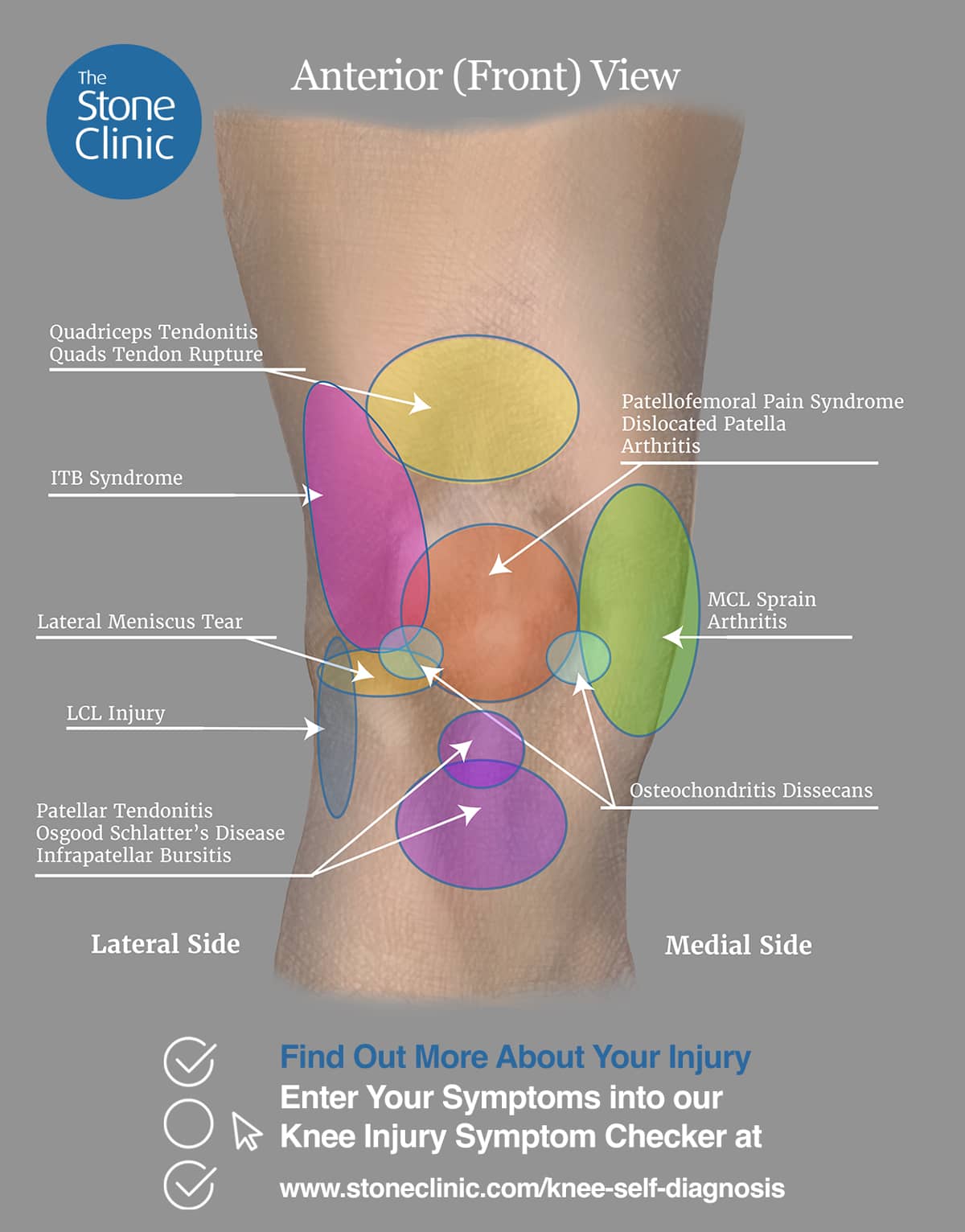
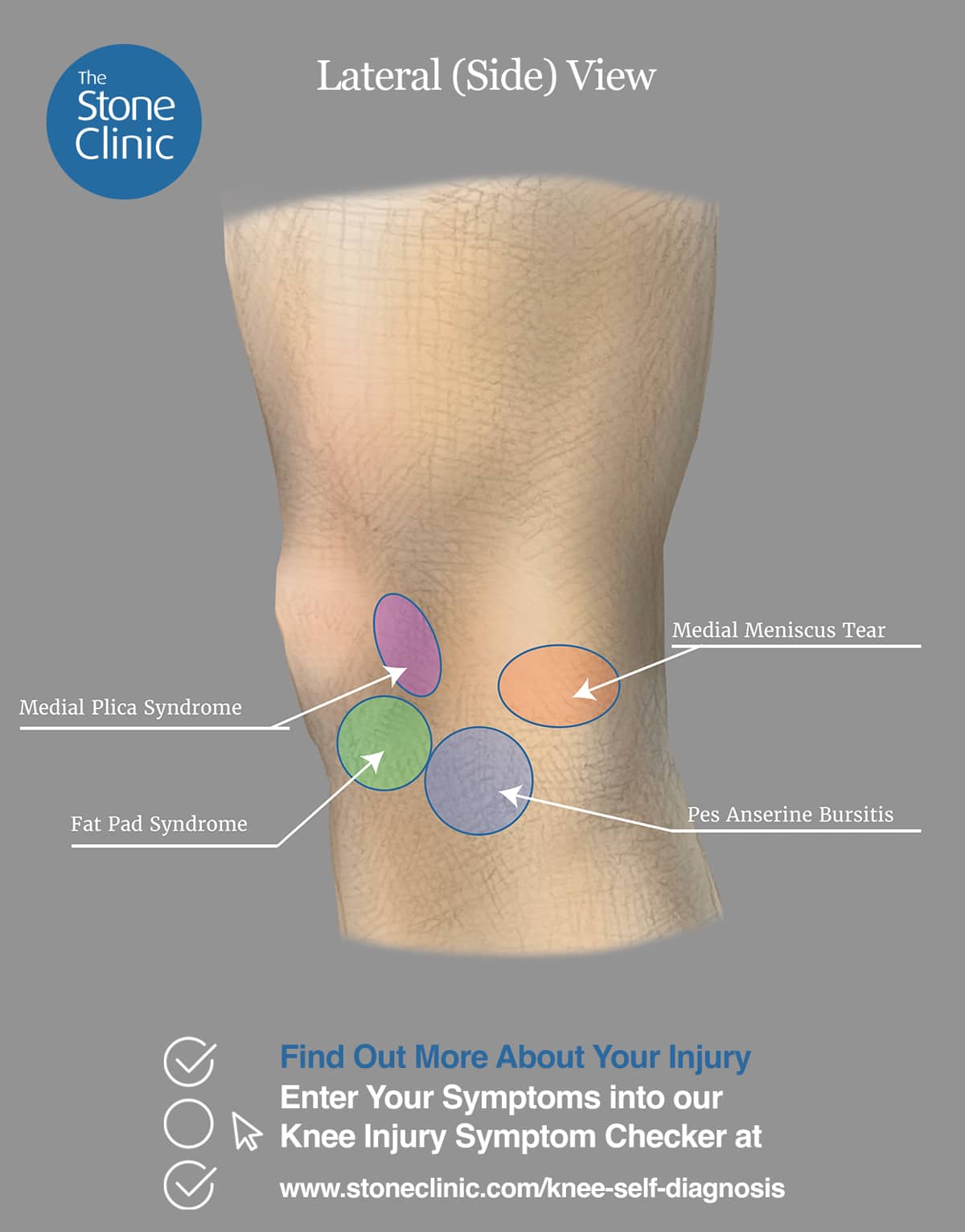
Knee Pain Location Chart
Below is a chart that provides an approximate guide as to which part of the anatomy may be injured based on the location of your pain. It is for informational purposes only and should not be used instead of seeking professional medical advice or diagnosis.


What to Do After Using the Symptom Checker
If your symptoms indicate a potential injury, don't wait for your injury to progress. Take the next step and begin your recovery journey with Dr. Stone now:
- Book an appointment online to see us in person, or you may call The Stone Clinic at +1 (415) 563-3110.
Schedule a complimentary telemedicine consultation. If you don't live in the San Francisco Bay Area, we offer a complimentary virtual pre-appointment consultation service.
Please note this pre-appointment service is only available for patients 100 miles outside the San Francisco Bay Area (and does not apply to any in-office services).
An Alternative to Knee Replacement: the BioKnee®
From our perspective at The Stone Clinic, the current standard of care for osteoarthritis is failing patients. Being told to “stop your activities, take painkillers, and wait until you need a joint replacement” is outdated and unacceptable.
It is possible to repair and prevent some types of osteoarthritis. Our BioKnee® program combines Dr. Kevin Stone's most innovative surgical procedures to create a revolutionary treatment for arthritis. This alternative to knee replacement has permitted hundreds of people with moderate to severe arthritis to return to full activity and delay or avoid a total joint replacement.
Frequently Asked Questions About Knee Pain
There are various reasons why knee pain may occur, including:
- Soft tissue injury
- Cartilage injury
- Bony injury
- Ligament instability
- Acute knee pain resulting from an injury, which may require treatments such as:
- ARICE = Active rest, ice, compression, elevation. (Active rest means exercising around your injury)
- Physical therapy
- Joint injections
- Surgery
- Knee osteoarthritis is the most common form of arthritis. Untreated, it is usually a progressive degenerative disease in which the joint cartilage gradually wears away.
- Post-traumatic arthritis may be caused by:
- A previous injury that was not effectively treated or managed
- Poor body mechanics
- Abnormal anatomy that wears on the joint over time
- Inflammatory arthritis, such as gouty arthritis, rheumatoid arthritis, or Lyme disease, and other medical conditions may also cause knee pain.
- Knee pain may also occur as a result of compensating for another injured or painful joint, such as the hip, ankle, or back.
Pain is not good for any tissue. It is a sign of damage or inflammation. If pain persists or interferes with daily life and activities, it is advisable to have it examined by a physician.
Here are some indications that your knee injury might require treatment:
- If your knee is swollen immediately following an injury and the swelling never subsides
- If your knee is still symptomatic after an injury
- If you experience any popping, buckling, weakness, instability, intense pain, or consistent swelling.
Minor aches and pains resulting from overuse of the knee tissues can subside or resolve over time. However, recurring pain, swelling, or other symptoms should be evaluated by a physician.
Knee popping and clicking can be caused by a few things listed below. For a more comprehensive overview of knee noise— including the most common causes, when it’s harmless, and when it signals an injury— read our guide to knee popping and clicking: causes and treatment. ”
- Scar tissue or irregular cartilage.
- Frequent popping and clicking during activity, or if it's hindering your activity, might be an indication that you should seek medical care.
- If the popping and clicking are associated with other symptoms, it might be an indication that there is an injury to the joint, most often a torn meniscus.
As for whether you should be worried, it's best to consult a doctor for a full diagnosis.
Possible causes of knee pain without injury include:
- Poor body mechanics
- Overuse
- Genetic anatomical abnormalities
- Inflammatory arthritis
- Unrecognized tear to the meniscus, ligaments, or articular cartilage
There are a few possible reasons why your knee may feel unstable, including:
- Ligament injury: The most common cause of knee instability is an injury to one of the ligaments that support the joint, most commonly the anterior cruciate ligament (ACL).
- Meniscus tear: A tear in the meniscus (the cartilage cushion between the thigh bone and shin bone) can also cause knee instability.
Knee pain when bending can be caused by:
- Mechanical block: It could be due to factors such as scar tissues, torn cartilage, bone spurs, loose bodies, or joint space narrowing that obstruct flexion. This is commonly associated with osteoarthritis, and surgical intervention may be necessary in such cases.
- Muscle or soft tissue tightness or injury: In other instances, the pain may be caused by tight muscles or soft tissue injury. Physical therapy with soft tissue massage and injections of lubrication (HA) and growth factors (PRP) can help alleviate these symptoms.
Knee swelling is not normal. Swelling in the joint typically indicates inflammation, which can be caused by various factors such as an injury, overuse, or an underlying medical condition.
Common causes of knee swelling include:
- Ligament or meniscus tears
- Tendinitis
- Bursitis
- Arthritis (such as osteoarthritis or rheumatoid arthritis)
- Fluid accumulation within the joint or behind the joint (Baker’s Cyst)
For more details on how to interpret knee swelling, you can find answers in Dr. Stone’s blog “Knee Swelling Q & A”
To prevent knee pain, you can maintain a healthy weight, engage in regular exercise that strengthens the muscles around the knee, wear shoes with good cushioning, optimize your gait, and moderate activities that put excessive stress on the joint.
To find out more strategies to manage knee pain and inflammation, be sure to read Dr. Stone's blog "What's Making Your Knee Pain Worse."
To manage knee pain at home, you can:
- ARICE = Active rest, ice, compression, elevation. (Active rest means exercising around your injury)
- Over-the-counter NSAIDs (Non-Steroidal Anti-Inflammatory Drugs): i.e., ibuprofen, naproxen
Determining if you need surgery for your knee pain depends on several factors including:
- Diagnostic imaging results (MRIs & x-rays)
- Cause and severity of your knee pain
- Impact on your daily activities
- Effectiveness of conservative treatments already been applied
Here are some indicators that may suggest the need for knee surgery:
- Conservative treatments have failed
- Significant functional limitations
- Structural damage or instability: If x-rays or MRIs reveal significant structural damage to your knee joint, such as a torn ligament, meniscus tear, or cartilage damage, surgery might be necessary to repair or reconstruct the affected tissues.
- Chronic conditions
- Traumatic injuries

Dr. Kevin R. Stone, a world-renowned orthopaedic surgeon, leads The Stone Clinic and chairs the Stone Research Foundation. Trained at Harvard and Stanford, he pioneers biologic orthopaedics, meniscus transplantation, and robotic knee surgery to restore joint health.
Dr. Stone specializes in restoring knee function through advanced regenerative techniques, outpatient robotic knee replacement, and cutting-edge solutions for cartilage regeneration.
For over 30 years, he and his team have specialized in giving people back their vital meniscus shock absorbers at the Meniscus Transplant Center. Recognized as one of the country’s top 75 knee surgeons1, he has treated elite athletes, served as a physician for the U.S. Ski Team and Smuin Ballet, and been featured in the New York Times, Wall Street Journal, TED Talks, Good Morning America, and more. He is also the best-selling author of Play Forever.
Why This Matters: This symptom checker tool was developed using Dr. Stone’s expertise to provide patients with the most advanced diagnostic insights and treatment pathways—helping you make informed decisions about your knee health.
-

Live in the San Francisco Bay Area?
-

Outside of the Bay Area?


