The Stone Foundation . . . . The Stone Clinic
.
Fitter, faster and stronger.
-
.Clinic Information
.Patient Information Forms
.Appointments
.About Us
.Patient Experiences
. News and Events
.Newsletter
. Podcasts
.Recent Papers
Treatment and Research
.Knee
.Shoulder
.Ankle
.Back
.Elbow
. Hip
. Stem Cells
. Biologic Joint Replacement
.Rehabilitation Programs
Sports and Fitness
.Nutrition
.Glucosamine
. Athlete Education
. Sports Exercises and Training
.
. Athletes Advisory Board


Osteochondritis Dessicans Lesions (OCD) of the Knee
K.R. Stone

-

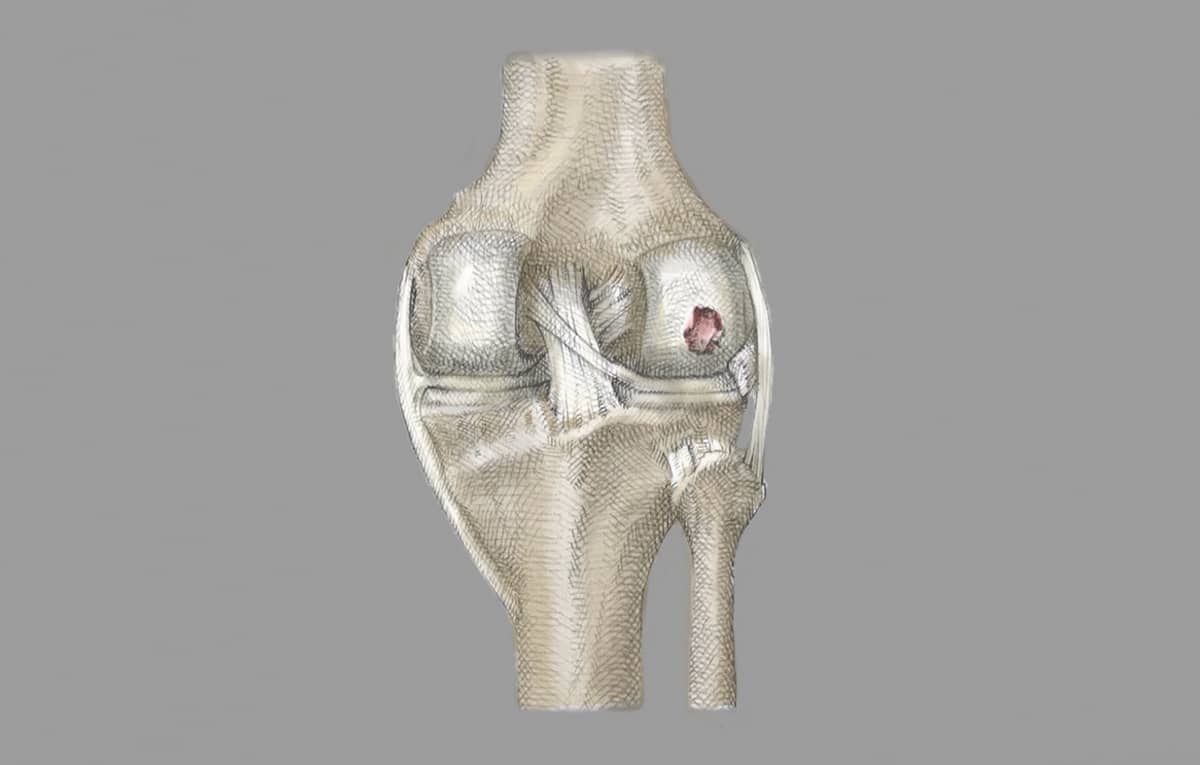
Contact between the femur (thigh bone) and the tibia (shin bone) occurs at the knee joint. The contact surfaces of these bones have a protective covering made of articular cartilage. Articular cartilage minimizes friction and wear across the joint and acts as a protective cover for the layers of subchondral and cancellous bone that lie beneath.

Osteochondritis Dessicans (OCD) is a disease in which localized osteocartilaginous separation at the level of the subchondral bone causes damage to the protective articular cartilage cover, subsequently producing pain and swelling. Unless the lesion repairs spontaneously or it is treated, the disease process progresses. The affected area of subchondral bone and its attached articular cartilage can become loose and separate into the joint. In fact, this is the most common source of loose bodies in the knee joint. OCD lesions may occur in any joint, but are most common in the knee. OCD is most common in people between the ages of 10-50 years old, with more men being afflicted than women.

The exact cause of OCD is unknown. Popular theories include:

  • Direct trauma to the joint
  • Joint instability
  • Injured structures of the joint such as meniscal tears and patellar dislocations
  • A decrease or absence of blood flow to the subchondral area
  • Abnormal bone development
  • A predisposition to develop OCD, genetic or otherwise

OCD patients may experience:

  • Chronic knee aching or swelling
  • A sensation of popping or catching in the knee
  • A palpable loose body in the joint

Proper diagnosis of OCD often requires X-ray and MRI, in addition to physical examination, for further assessment of a lesion.

Treatment of OCD depends on patient age and lesion size. Many children respond well to non-operative treatment while adults often require diagnostic arthroscopy to both evaluate and potentially treat lesions. At arthroscopy lesions are classified into 4 groups:

  • Group 1:Intact lesion with a continuous, yet mildly irregular articular cartilaginous surface
  • Group 2: Signs of early separation with the articular surface showing increasing irregularity
  • Group 3: Lesion is partially detached
  • Group 4: A crater is revealed at the surface of the bone and a loose body is present

Surgical procedures to treat OCD lesions include reduction and fixation, open or arthroscopic drilling, debridement, bone grafting, autologous chondrocyte implantation, osteochondral autografts, periosteal/perichondral autografts, and osteochondral allografts.

If treatment using a fixation device fails, an even larger lesion may result. In this case, Orthopaedists are faced with difficult questions regarding future therapy. Treatment options include: A) another trial of the surgical treatments listed above or B) knee replacement with metal and plastic parts (arthroplasty). Knee replacement is not a desirable option in young patients because knee replacements require revision surgery within 10 – 20 years.

Arthroscopic Articular Cartilage Paste Grafting has been used by Dr. Stone for the past 15 years to treat arthritic and traumatic lesions of the knee in over 200 cases with excellent pain relief. A study of the 2 -12 year outcomes of Articular Cartilage Paste Grafting to treat arthritic lesions were recently published and can be found here. The goal in treating arthritic lesions, traumatic lesions, and failed OCD lesions with Articular Cartilage Paste Grafting is the same The intent is to stimulate a healing response that covers the lesion with a protective layer of fibrocartilage and/or hyaline cartilage. The regenerate cartilage protects the underlying bone and serves to reduce pain and swelling. Articular Cartilage Paste Grafting has been successfully applied to OCD lesions as both a primary treatment and as a salvage procedure for defects that fail other attempts at repair.

The following are stories of 2 patients with OCD lesions who had Articular Cartilage Paste Grafting procedures performed for repair of lesions that failed previous surgical attempts at repair.

Patient #1

A 25 year old athletic male, presented at the Stone Clinic after failing screw fixation of a large OCD lesion. He initially injured his knee at the age of 12 and developed progressive knee pain. The pain was so severe by his junior year in high school that he had to hold on to walls to walk. At the age of 18, X-RAYs revealed a large OCD lesion involving the weight-bearing surface of the medial femoral condyle. The OCD lesion was separating from the subchondral bone and he subsequently underwent a knee arthrotomy (open knee surgery) with elevation of the articular cartilage flap, debridement of the crater, and flap fixation with 2 fixation screws. Post-operative arthrograms and X-RAYs appeared to show good position of the screws and the fragment, but he continued to have pain and popping in his knee.

At 20 years old, a CT scan revealed a nonunion of the fracture fragment, which led to another surgery to tighten the loose fixation screw. His pain continued to progress. Another surgery was performed to remove the fixation screws and the unstable OCD lesion (see photo). He was then referred to the Stone Clinic for Articular Cartilage Paste Grafting.

Preoperative X-RAYs and MRI revealed a large OCD lesion with underlying avascular necrosis involving a large portion of the femoral condyle.

.
Pre-operative MRI showing the OCD lesion

At arthroscopy, a lesion measuring approximately 35 mm x 40mm was found with a depth of 30 mm.

.

Osteochondritic lesion

The hard, sclerotic base of the OCD lesion was morselized until bleeding occurred. Articular cartilage and cancellous bone were harvested from a non-weight bearing region of the knee. The articular cartilage and cancellous bone were smashed to form a paste in a bone graft crusher and then arthroscopically impacted into the lesion.

.
.
Articular cartilage defect site
Morselization of the articular cartilage lesion
.
.
Harvest of articular cartilage and bone
Manual crusher used to make the paste graft
.
.
Impacting the paste graft into the morselized defect
Articular cartilage paste grafting, medial femoral condyle, OCD lesion

Postoperatively, the patient was kept non-weight bearing for 4 weeks using crutches. A CPM unit was used in a range of motion from 0 degrees to 75 degrees for 6 hours each night for 4 weeks. Stationary bike and pool exercises with minimal resistance were started at 2 weeks. Impact sports were initiated after 3 months.

The patient noted immediate relief of pain. At 26, he stated that he had not been free from pain since he was 12 years old. At the 8 month follow up he graded his knee as normal in activities of daily living including walking, stairs, squatting, and kneeling. He water-skies regularly.

Three months later, while squatting down with a flexed knee, he felt a pop and developed immediate pain and swelling. Repeat arthroscopy revealed a hypertrophic healing response fully covering the defect.

.
.
Figure 1:
Surgical appearance of OCD lesion,
8 months after articular cartilage paste grafting.
Figure 2:
Surgical appearance of OCD lesion,
8 months after articular cartilage paste grafting.

20 months after the original graft he reported no pain with all activities on the validated WOMAC Osteoarthritis Index.

Almost 10 years after receiving an Articular Cartilage Paste Graft, at the age of 36, he recently competed at the International Race at Donner in Lake Tahoe, Ca. He finished with the following times:

Distance Time
Swim 3/4 mile 27 min
Bike 25 miles with 1200ft ascent 1hr 45 min
Run 6.5 miles 1hr 10 min
Overall time 3hrs 30min  
Overall rank 259/330  
.
.
.

Patient #2

A 39 year old male presented with a failed osteochondral autograft transplantation and fixation procedure for an OCD lesion located at the weight-bearing surface of the medial femoral condyle.

 .
Retained hardware in medial femoral condyle, 7 months after failed OATS procedure.

He reportedly grew 5 inches in 4 – 5 months when he was 15 and developed knee pain around that time. Beginning around age 18 he underwent 3 surgeries with debridement and suspected abrasion chrondroplasty. In April of 1998 an OATS procedure (a type of osteochondral autografting) was performed at the central aspect of the lesion while a portion of the OCD lesion was stabilized using absorbable screws. He was pain free until October 1998 and an MRI was obtained revealing a large chondral defect and an apparent loose body.

.
Pre-operative MRI of the OCD lesion

Under Dr. Stones’ care, the resorbable pins were removed at arthroscopy in 1998 and an Articular Cartilage Paste Graft was applied to the 20 mm by 25 mm lesion that was 25 mm in depth at the medial femoral condyle using the same technique as previously described.

.
OCD, chondral defect after debriding.

.
Articular cartilage paste grafting, medial femoral condyle, OCD lesion

.
OCD cartilage defect during Articular Cartilage Paste Grafting

Postoperatively, the patient was kept non-weight bearing for 4 weeks using crutches. A CPM unit was used in a range of motion from 0 degrees to 75 degrees for 6 hours each night for 4 weeks. Stationary bike and pool exercises with minimal resistance were started at 2 weeks. Impact sports were initiated after 3 months. He eventually returned to full sports and rated his knee as greatly improved.

While rollerblading in December of 1999 he crashed onto the surgical knee. By February 2000 he developed increasing pain, catching, and limping. At arthroscopy, 14 months after the articular cartilage graft was placed, the condyle appeared well healed with a thickened fibrous cover.

. 
Appearance of the medial femoral condyle 14 months post articular cartilage paste grafting of the OCD lesion.

He is now free from pain and knee swelling. He skis, plays golf, and jet skis without complaint

The patients described above presented with debilitating pain and large OCD lesions on the weight bearing surfaces of their medial femoral condyle that were not remedied by prior treatment attempts. Articular Cartilage Paste Grafting successfully induced regenerate cartilage tissue growth over the OCD lesions, provided dramatic pain relief, and allowed for participation in demanding athletic sports for both patients.

Get more information on articular cartilage paste grafting.

The Stone Clinic

3727 Buchanan Street • San Francisco CA 94123 • info@stoneclinic.com • (415) 563-3110

.