The
Injury General
Considerations: Mid-shaft
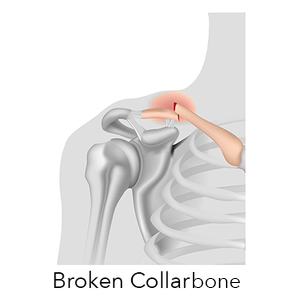
clavicle fractures occur most commonly from falls onto the shoulder. We see the
most from bicycling, skiing and snowboarding falls. Clavicle fractures present
a unique challenge to self-healing because the shoulder cannot be placed in a
cast during the healing process. The clavicle is directly under the skin with
no overlying fat, making fractures cosmetically apparent, and moreover, they hurt.
Surgical fixation
of the clavicle is being recommended more frequently in order to promote healing.
Recent studies indicate long-term shoulder weakness and mal-union from fractures
with an overlap or a distraction of more than 1 centimeter when left untreated.
A new intramedullary fixation technique has permitted normal alignment and restoration
of length of the clavicle with an early return to work and sports. The risks of
surgery, including non-union and infection, are still present; however, for athletes
who want to return to full sports as early as possible, and for people who are
concerned about optimal anatomic alignment and healing, this technique has served
these patients well. The indications, surgical technique and rehabilitation program
is described here. Surgical
treatment - Indications: - Mid-shaft
clavicle fractures with overlap or displacement greater than 1 centimeter.
- Tenting
of skin by fracture fragments
- Active
patient with desire for early return to work and healing with no loss of length
or strength.
Surgical
treatment - Contraindications: - Skin
wounds at the incision site.
-
Inability to follow the rehabilitation program.
Surgical
treatment - Pro's: Surgical
intervention can allow the patient to: - regain
length.
- regain
stability.
- return
to work.
Furthermore,
surgical fixation will promote proper healing by preventing: - overlap
between the fractured bone.
- development
of a fibrous non-union.
Surgical
treatment - Con's: - Higher
infection rate estimated at less than 1%.
- Potential
hardware complications or failure.
- Skin
incisions.
- Non-union
risk.
- Surgical
regional block risks.
Surgical
Technique The
patient is seated in the beach-chair position after an interscalene local anesthetic
block is placed. The fracture ends are opened with a scalpel and cleaned. A guide
pin is passed into the medial portion of the clavicle under fluoroscopic x-ray
control and over-drilled to fit a 6.5 mm or 4.5 mm screw. The guide pin is then
removed and passed into the lateral clavicle fragment and similarly over-drilled.
The pin is directed out the back of the clavicle. The drill is attached to the
exiting end and redirected to pin the full length of the clavicle under x-ray
control. Finally, a cannulated screw and washer is passed from the back down
the bore of the clavicle to fix the fracture. Care is taken to engage, but to
not penetrate, the medial end of the cortex of the bone. The incision is then
closed. The
following is an x-ray image of a mid-shaft clavicle fracture:
(Rollover
the image to highlight the injury.) 
X-rays
demonstrating this reduction of the fractured mid-shaft clavicle in a professional
Race Across America cyclist, who cycled within one month of his injury:
(Rollover the
image to highlight the injury repair.) 
Post
-Operative Rehabilitation General
Considerations: - DO
NOT elevate surgical arm above 70 degrees in any plane for the first 4 weeks post-op.
- DO
NOT lift any objects over 5 pounds with the surgical arm for the first 6 weeks.
- AVOID
REPEATED reaching for the first 6 weeks.
-
Ice shoulder 3-5 times (15 minutes each time) per day to control swelling and
inflammation.
- An
arm sling is used for 3- 4 weeks post-op.
- Maintain
good upright shoulder girdle posture at all times and especially during sling
use.
- Intermittent
X-ray to monitor healing as needed
-
M.D. follow-up visits at Day 1, Day 8-10, Month 1, Month 3 and Year 1 post-op.
Week
1: - M.D.
visit day 1 post-op to change dressing and review home program.
- Exercises
(3x per day):
- pendulum
exercises
- squeeze
ball
- triceps
with Theraband
- isometric
rotator cuff external and internal rotations with arm at side
-
isometric shoulder abduction, adduction, extension and flexion with arm at side.
-
Soft-tissue treatments for associated shoulder and neck musculature for comfort.
- Cardiovascular
training such as stationary bike throughout rehabilitation period.
Weeks
2 - 4: - Soft-tissue
treatments for associated shoulder and neck musculature for comfort.
- Gentle
pulley for shoulder ROM 2x/day.
- Elbow
pivots PNF, wrist PNF.
- Isometric
scapular PNF, mid-range.
Weeks
4 - 8: - M.D.
visit at Week 4 post-op and will usually be progressed to a more aggressive ROM
and strength program.
- At
Week 4: start mid-range of motion (ROM) rotator cuff external and internal rotations
active and light resistance exercises (through 75% of ROM as patient's symptoms
permit) without shoulder elevation and avoiding extreme end ROM.
- Strive
for progressive gains to active 90 degrees of shoulder flexion and abduction.
Weeks
8 - 12: - Seek
full shoulder Active ROM in all planes.
- Increase
manual mobilizations of soft tissue as well as glenohumeral and scapulothoracic
joints for ROM.
- No
repeated heavy resisted exercises or lifting until 3 months.
Weeks
12 and beyond: - Start
a more aggressive strengthening program as tolerated.
- Increase
the intensity of strength and functional training for gradual return to activities
and sports.
- Return
to specific sports is determined by the physical therapist through functional
testing specific to the injury.
|